Showing posts with label birds. Show all posts

Colorful Mandarin Duck

mandarin duckMale Mandarin Ducks are easily recognizable because of their abundant and gorgeous coloring. 

Even in shaded areas, like the photo on the right, their brilliance is discernible if you look carefully.  Ironically, I almost overlooked that Mandarin duck because those varied colors also provide an excellent camouflage on land.

The Mandarin Duck rests during the day on land, often under overhanging shrubs near water. 


mandarin duck


Facts About the Mandarin Duck


  • Woodland & wooded areas duck (not a Wood Duck!)
  • Genus:  Aix (water bird) galericulata (small capped head) - which is shared only with the Wood Duck
  • Length - up to 18.5 inches
  • Weight - less than 3 lbs
  • mandarin duck
  • Region - Originally East Asia, but has been introduced to other parts of the world 
  • Largest populations are now found in Japan & England
  • They are not hunted as food since they don't taste very good
  • They prefer to feed at dusk and eat acorns, nuts, rice, grapes, seeds, plants, flowers like roses or rhododendrons, insects, snails and small fish.
  • Preferred Nest - hole in a tree lined with down 
  • Mandarin Ducks keep the same mating partner through several mating seasons instead of choosing a new partner
  • Sexes Differ in Appearance - Males are vibrantly colored, Females are very pretty grayish brown & white with blue tips on a few of her feathers.  The white eye ring and stripe makes her identifiable as a female Mandarin Duck.

Don't they make a lovely couple!

Because of their monogamy,  Chinese culture regards them as symbols of fidelity and affection, therefore they are often used in Chinese art.


Note: The author may receive a commission from purchases made using links found in this article. “As an Amazon Associate I earn from qualifying purchases.”

West African Crowned Crane


West African Crowned Crane Face
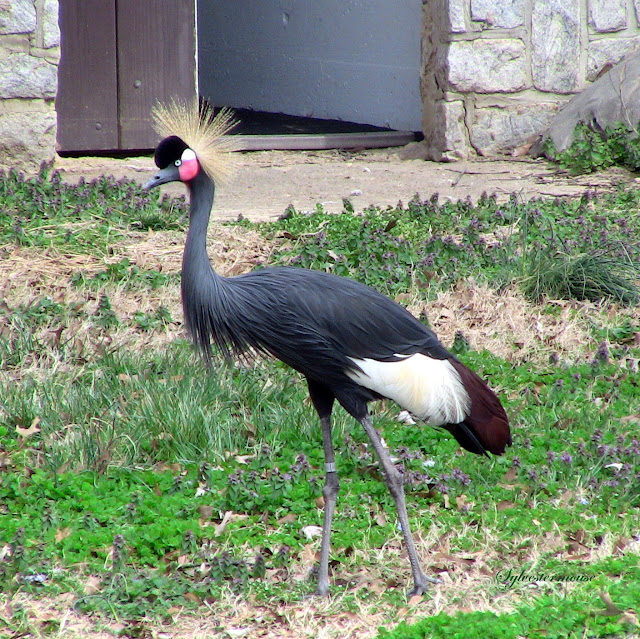
West African Crowned Crane - Balearica pavonina
The coloring on animals is always so fascinating!  Take a close look at the face on this West African Crowned Crane.  The pinkest red patch on his face is the perfect accent to set off his lovely eyes.  His head is topped with a golden crown of feathers.

The golden crown is even more stunning when you see the lush grey feathers covering his body.  Such perfection looks painted, yet this photo is untouched.

The stand of the crown, the color of the eyes and the lay of his feathers are exactly as God created him.

West African Crowned Crane
 

West African Crowned Cranes


Like all cranes, the West African Crowned Crane has the long slender neck that makes them so easy to classify as cranes.  However, he stands apart from other cranes in one very distinct way.  He is the only crane can roost in trees. 
West African Crowned Cranes 
More Facts About the West African Crowned Crane

  • Also known as Black-crowned Crane
  • Height:  32" - 36" 
  • Weight:  Approx. 8 lbs
  • Diet:  Plants, Insects, Rice, Grain, Reptiles & Fish
  • Lifespan:  20 yrs. in the wild - 60 yrs in captivity
  • Mate for Life
    (if successful in breeding.  The will change mates if no babies are born after the first breeding season together)
  • Region:  West Africa  - Specifically in the marshy areas.  Along the shores of lakes & ponds.
  • National Bird of Nigeria
  • Status:  Vulnerable
 
Like so many animals today, the West African Crowned Crane is on the endangered species list.  In addition to the natural threats of predators like snakes and birds of prey, the encroachment of humans into their habitat and pollution of their water has played a large part in their decreased population.  Sadly for the Black-crowned crane, they are at even greater risk because they are captured and sold to bird collectors.


Note: The author may receive a commission from purchases made using links found in this article. “As an Amazon Associate I earn from qualifying purchases.”
Blue Masked Leafbird

http://www.amazing-wild-animals.com/
Because of his lovely green color and very small size, it is actually pretty easy to see why this gorgeous little bird is named a leafbird.  In the canopy of trees, the leafbird could go virtually unnoticed unless he moves or sings to attract attention.  

It is also clear to see why he is call a "blue-masked" leafbird.  He does look like he is wearing a big blue mask on his face.  The blue and yellowish colors of his feathers also help him to blend in with his colorful tropical surroundings on the island of Sumatra in western Indonesia.  

The Blue Masked Leafbird is Near Threatened 


Facts About the Blue Masked Leafbird

(Chloropsis venusta)


http://www.amazing-wild-animals.com/
The Blue Masked Leafbird - Photo by Sylvestermouse


  • Near Threatened Species due to loss of habitat
  • Indigenous to Indonesian island of Sumatra
  • Classification:  Songbird
  • Nests at end of branches in the top of trees
  • Smallest of the Leafbird species  
  • Size:  5.5" in length from tip of beak to tip of tail 
  • Weight - half ounce  
  • Food:  Insects, Berries, Fruit, and Tubular Flower Nectar

Like hummingbirds, the little Blue Masked Leafbird collects pollen while eating.  Therefore, as he flies from one flower to the next,  he cross-pollinates flowers while he is drinking the nectar from each flower.   A great example of how animals and flowers help each other survive in nature.


Video of the Blue Masked Leafbird


I do love songbirds, but I don't normally include videos on the Amazing Wild Animals site.  However, I wanted you to be about to hear this little songbird for yourself.

Close your eyes and listen!  He will make you feel like you are resting under a canopy of trees, or walking through the Rainforest.


There aren't many Blue Masked Leafbird products available, so I added my own photo to a mug on Zazzle. If you would like to have this photo on a different Zazzle item, please leave me a note in the guestbook below. I'll be happy to add it for you.
& 


Note: The author may receive a commission from purchases made using links found in this article. “As an Amazon Associate I earn from qualifying purchases.”

Bali Mynah - Critically Endangered Bird

Bali Starling Photo by Sylvestermouse
You may never have seen or heard of a Bali Mynah aka the Bali starling.  This gorgeous bird is critically endangered, largely due to illegal poaching for captive bird trade.  Unfortunately, their rarity has only increased the demand and value to poachers.

Counts in recent years indicate there may be fewer than 20 Bali Mynah birds still in the wild.

Even though there are some Bali starlings in zoos, there are still less than 1100 total known in existence today.  Attempts to release the birds back into the wild have only resulted in them disappearing.  Most likely into the hands of illegal poachers.


Description of the Bali Mynah


The Bali Mynah is a snow white bird.  His only coloring will be found in the blue around his eyes and the black on the tips of his tail and wing feathers, which look like they have been dipped in black ink.

Bali Starling Photo by Sylvestermouse
Photo by Cynthia Sylvestermouse

I felt quite privileged to see the lovely Bali Mynah in person myself.  We should never move so fast that we don't take the time to really stop, look and appreciate the lovely creatures that share the earth with us right now.  Some won't be here for our great grandchildren to see.  All that will be left are the photos and memories.


Facts About the Bali Mynah  

(Leucopsar rothschildi)

By Woldere CC BY-SA 4.0-3.0-2.5-2.0-1.0
(http://creativecommons.org/licenses/by-sa/4.0-3.0-2.5-2.0-1.0)],
via Wikimedia Commons

  • Critically Endangered
  • Only found in the northwestern tip of the Indonesian island of Bali
  • Mostly Snowy White
  • Monogamous
  • Member of the Passeriformes or Perching bird order
  • Normal Body size 8.5" females & 9" - 10" males
  • Weight:  3 - 3.5 ounces
  • Diet:  Insects, Worms, Seeds and Fruit
  • May live up to 25 years in Captivity
  • Also known as Rothschild's mynah


The photo above on the right was used with permission.  I wanted you to be able to see the black tipped wing tips and tail feathers.   That is most likely a female in photo since the male no longer has a crown or crest.  She preens her crest to attract her life-long mate during mating season.


Learn More about the Bali Mynah or Purchase Bali Mynah Gifts

& 


Note: The author may receive a commission from purchases made using links found in this article. “As an Amazon Associate I earn from qualifying purchases.”

Micronesia Kingfisher

©Sylvestermouse -- All Rights Reserved
This beautiful bird is now extinct in the wild.   The last wild Micronesia Kingfisher was seen in 1988.  Less than 155 of these extraordinary birds reside in zoos, which are all participating in a breeding program with the hopes of starving off complete extinction of the Micronesia Kingfisher.

These precious little birds were a native species of Guam that was decimated by the accidental introduction of the predatory brown tree snake to the Micronesian islands during WWII by cargo ships and planes.

A small number of Micronesia Kingfishers were recently returned to the island, but continue to be held in captivity there.  They hope to be able to return them to the wild to a near-by snake-free island to once again freely inhabit their native area. 


More Facts about the Micronesia Kingfisher


Head-body length:  6" 
Wingspan:  8"
Weight:  2 - 2.6 ounces
Food:  Primarily insects, lizards, hermit craps or small crustaceans

Nest: In a hole in tall tree or coconut palm
Clutch Size:  Usually only 2 eggs

Usually live in pairs
Both parents tend their eggs


©Sylvestermouse -- All Rights Reserved

Sounding the Alarm


can even flap their wings fast enough to hover over water. - See more at: http://animals.sandiegozoo.org/animals/kingfisher#sthash.k4aEetU6.dpuf
It is said that you could tell time by the first call of the Micronesia Kingfisher each day because he "sounds the alarm" at the same time every morning, which is usually at dawn.

This is such a beautiful and precious bird.  I, for one, am really glad that someone sounded the alarm about their quickly decreasing numbers, and that so many responded to the call before they became  extinct.


Image Credit for Photos: 

All Photos are by Sylvestermouse


All photos on this site are the exclusive property of Sylvestermouse and should not be copied without written permission.


Note: The author may receive a commission from purchases made using links found in this article. “As an Amazon Associate I earn from qualifying purchases.”

The Nicobar Pigeon

There are many colorful birds that add beauty to our days and to our lives. The Nicobar Pigeon is not likely one you will see in your own backyard, unless you happen to live in a tropical rainforest.   

Where You Can Find a Nicobar Pigeon


The Nicobar Pigeon is indigenous to the Nicobar Islands, an island chain in the Indian Ocean, as well as Cambodia, India, Indonesia, Malaysia, Myanmar, Palau, Papua New Guinea, Philippines, Solomon Islands, Thailand, and Vietnam where sadly, they are hunted by numerous predators. In an attempt to save the near threatened Nicobar Pigeon from extinction, many zoos have become the home for this exotic beauty where it can be viewed living in ignorant bliss.


Colors of the Nicobar Pigeon


As you can see in the photos, their gray heads and body serve as the perfect background for a host of spectacular color. My little friend above hides a lovely rainbow beneath his wing. I felt rather honored that he waved to me at just the right moment for me to catch that shot to share with the world. His white tail is an indication that he is an adult Nicobar Pigeon since they are not born with a white tail. 
 

Heritage of the Nicobar Pigeon


Studies indicate that the Nicobar Pigeon is the closest living relative to the extinct Dodo bird, which current DNA studies link to the Pigeon family.


Image Credit for Postcards    Nicobar Pigeon Post Cards by Sylvestermouse

Additional Nicobar Pigeon Merchandise: Nicobar Pigeon Items in the House of Sylvestermouse

All of these Nicobar Pigeon photos are the exclusive property of Sylvestermouse and should not be copied without permission. However, they are available through Zazzle if you would like to purchase one.


Note: The author may receive a commission from purchases made using links found in this article. “As an Amazon Associate I earn from qualifying purchases.”

“As an Amazon Associate I earn from purchases.” Disclosure Statement

X