Showing posts with label near Threatened species. Show all posts

Southern White Rhino

Southern White Rhino Facts & Photos
The White Rhinoceros is quite impressive in size.  They are the second largest land mammal and are surprising non-aggressive.  Their size is only exceeded by the elephant.  Ironically, they are grazers and eat primarily short grasses and leaves.

In the late 19th century, Southern White Rhinos were thought to be extinct.  However, a small herd was found in 1895 and they have been protected ever since.  Statistics now indicate that there are over 20,000 living Southern White Rhinos and they are the only rhinos that are not endangered at this time.   Unfortunately, that makes them a target for poachers and the illegal trade of their horns, which are consumed by the wealthy as a symbol of their elite status.

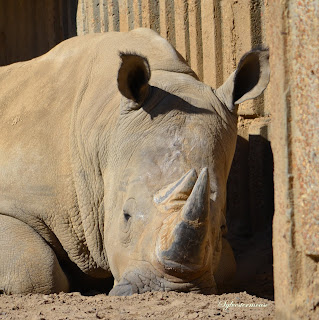
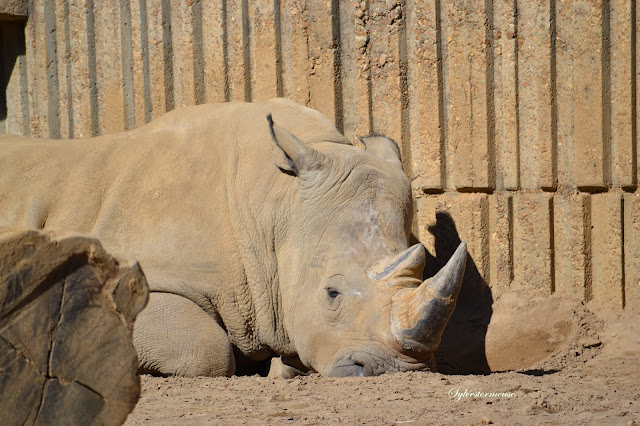
I couldn't help but think what a gentle giant this sweet Southern White Rhino was when I was photographing her.  She has such a serene look on her face.  She might not normally be the kind of animal that we would find endearing, but this one was.  I only had to stop long enough to really look and pay attention to her.  Oh, and if you look closely at the introduction picture, you can see the hair fringing her ears.
Southern White Rhino
Photo by Cynthia Sylvestermouse


Facts About the Southern White Rhino 


Left Image Attribution:
By TomFawls [CC BY-SA 3.0
  (https://creativecommons.org/licenses/by-sa/3.0)],
from Wikimedia Commons

Right Image Attribution: 
By Ltshears [CC BY-SA 3.0
  (https://creativecommons.org/licenses/by-sa/3.0)],
from Wikimedia Commons
 If you are wondering how you can tell the difference between a Southern White Rhino and other rhinos, you would need to look closely at their mouth.

The Southern White Rhino (image on the left) has a square muzzle instead of the pointed upper lip of the black rhino (image on the right).   

  • Life Span (wild):  30 yrs 
  • Life Span (captivity):  40 yrs
  • Weight:  Up to 5000 pounds 
  • Diet:  Grass & Leaves
  • Almost No Hair 
  • Most Hair found on tail & ears
  • Two Horns
  • Front Horn Length - Up to 60"  (average 24")
  • Regions: South Africa, Zimbabwe, Kenya and Namibia
  • Near Threatened (previously endangered)


Note: The author may receive a commission from purchases made using links found in this article. “As an Amazon Associate I earn from qualifying purchases.”

Bongo Antelope

Bongo
The Bongo is one of the largest antelopes in the dense African forest.  They have been called "shy", but I believe they simply exhibit an extremely acute survivalist instinct.  They run for cover immediately when they sense danger or any other animal around.

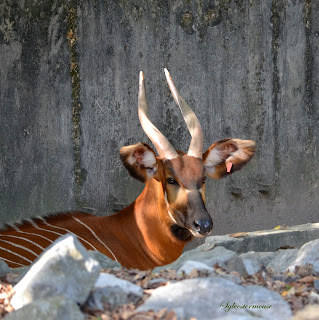
When spotted, they are easy to identify by their size, as well as their deep chestnut coloring with long white stripes that extend from side to side across their back.  In the photos, you will also note that they have distinctive white marks along the side of their face, on their ears and neck.   Their legs also have dashes of white markings.  The alternating white and reddish brown coloring make an excellent camouflage in the rainforest.

Take a moment to really look at the Bongo.  They are really quite beautiful!

Bongo
This Bongo was kind enough to show off her white markings! 
Note the white lines on the side of her face, on her ears, and on her neck. 


 Facts about the Bongo

  • Near Threatened status
  • Up to 8.25 ft
  • Weights up to 485 lbs.
  • Life span:  20 years
  • Both Males & Females have horns
  • Shorter legs than other antelopes
  • Spiral horns 
  • Horn length up to 39" with one twist
  • Herbivores - They eat plants, fruits, grass, leaves, thistles, flowers and twigs 
  • Run in small herds of couples.  Normally, the herd will contain an equal mix of sexes 
  • Region:  West Africa, northern Kenya, southern Sudan and the Congo


Their lyre shaped horns are one of their most interesting features.  As mentioned in the facts above, their horns are spiral shaped with one twist, which you can see in the introduction photo.  Bongos use their horns to pull and break branches for easier access to their desired food.  They run with their heads thrown back so their horns are against their necks to keep from getting tangled in the surrounding vegetation. 

Not only must they fear carnivores in their natural habitat, they are also hunted for their meat.  Sadly, big game hunters will also track and kill these beautiful antelopes.  All of these factors contribute to their "near threatened" status.


Note: The author may receive a commission from purchases made using links found in this article. “As an Amazon Associate I earn from qualifying purchases.”

Blue Masked Leafbird

http://www.amazing-wild-animals.com/
Because of his lovely green color and very small size, it is actually pretty easy to see why this gorgeous little bird is named a leafbird.  In the canopy of trees, the leafbird could go virtually unnoticed unless he moves or sings to attract attention.  

It is also clear to see why he is call a "blue-masked" leafbird.  He does look like he is wearing a big blue mask on his face.  The blue and yellowish colors of his feathers also help him to blend in with his colorful tropical surroundings on the island of Sumatra in western Indonesia.  

The Blue Masked Leafbird is Near Threatened 


Facts About the Blue Masked Leafbird

(Chloropsis venusta)


http://www.amazing-wild-animals.com/
The Blue Masked Leafbird - Photo by Sylvestermouse


  • Near Threatened Species due to loss of habitat
  • Indigenous to Indonesian island of Sumatra
  • Classification:  Songbird
  • Nests at end of branches in the top of trees
  • Smallest of the Leafbird species  
  • Size:  5.5" in length from tip of beak to tip of tail 
  • Weight - half ounce  
  • Food:  Insects, Berries, Fruit, and Tubular Flower Nectar

Like hummingbirds, the little Blue Masked Leafbird collects pollen while eating.  Therefore, as he flies from one flower to the next,  he cross-pollinates flowers while he is drinking the nectar from each flower.   A great example of how animals and flowers help each other survive in nature.


Video of the Blue Masked Leafbird


I do love songbirds, but I don't normally include videos on the Amazing Wild Animals site.  However, I wanted you to be about to hear this little songbird for yourself.

Close your eyes and listen!  He will make you feel like you are resting under a canopy of trees, or walking through the Rainforest.


There aren't many Blue Masked Leafbird products available, so I added my own photo to a mug on Zazzle. If you would like to have this photo on a different Zazzle item, please leave me a note in the guestbook below. I'll be happy to add it for you.
& 


Note: The author may receive a commission from purchases made using links found in this article. “As an Amazon Associate I earn from qualifying purchases.”

The Nicobar Pigeon

There are many colorful birds that add beauty to our days and to our lives. The Nicobar Pigeon is not likely one you will see in your own backyard, unless you happen to live in a tropical rainforest.   

Where You Can Find a Nicobar Pigeon


The Nicobar Pigeon is indigenous to the Nicobar Islands, an island chain in the Indian Ocean, as well as Cambodia, India, Indonesia, Malaysia, Myanmar, Palau, Papua New Guinea, Philippines, Solomon Islands, Thailand, and Vietnam where sadly, they are hunted by numerous predators. In an attempt to save the near threatened Nicobar Pigeon from extinction, many zoos have become the home for this exotic beauty where it can be viewed living in ignorant bliss.


Colors of the Nicobar Pigeon


As you can see in the photos, their gray heads and body serve as the perfect background for a host of spectacular color. My little friend above hides a lovely rainbow beneath his wing. I felt rather honored that he waved to me at just the right moment for me to catch that shot to share with the world. His white tail is an indication that he is an adult Nicobar Pigeon since they are not born with a white tail. 
 

Heritage of the Nicobar Pigeon


Studies indicate that the Nicobar Pigeon is the closest living relative to the extinct Dodo bird, which current DNA studies link to the Pigeon family.


Image Credit for Postcards    Nicobar Pigeon Post Cards by Sylvestermouse

Additional Nicobar Pigeon Merchandise: Nicobar Pigeon Items in the House of Sylvestermouse

All of these Nicobar Pigeon photos are the exclusive property of Sylvestermouse and should not be copied without permission. However, they are available through Zazzle if you would like to purchase one.


Note: The author may receive a commission from purchases made using links found in this article. “As an Amazon Associate I earn from qualifying purchases.”

“As an Amazon Associate I earn from purchases.” Disclosure Statement

X